
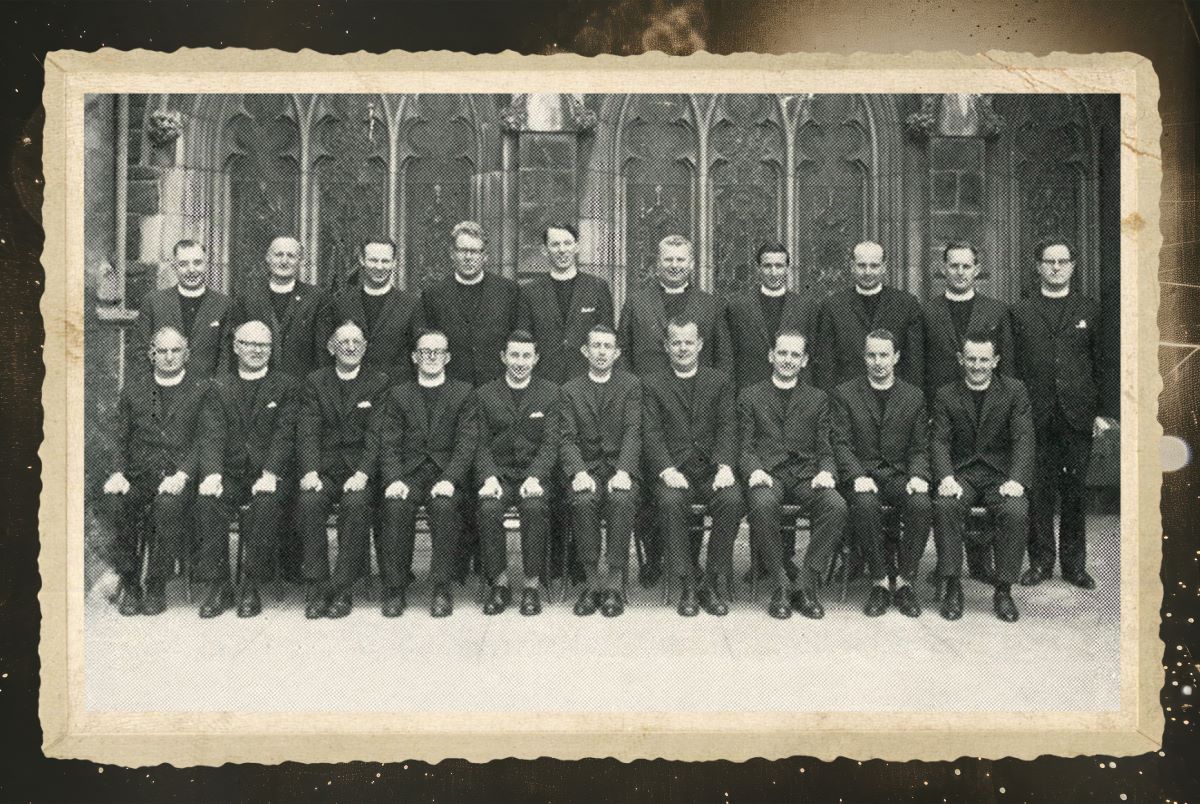
Rev Dr D’Arcy Wood and Rev Bruce Barber (front row, third and second from right) were ordained together 60 years ago.
By Marina Williams
D’Arcy Wood and Bruce Barber met at Wesley College in Melbourne in 1948, when D’Arcy was 11 and Bruce 10.
When the form teacher read out Bruce’s surname, D’Arcy wondered if his new classmate was the son of Rev Professor Calvert Barber, who taught theology at Queen’s College.
He was. Bruce had grown up on the college grounds, surrounded by theological students he admired.
“In a room of 30 boys, I happened by chance to take a seat in front of D’Arcy,” Bruce recalls.
They were often in different classes but stayed friends. D’Arcy sometimes holidayed with the Barber family. Bruce was best man when D’Arcy married Janet in 1961, and D’Arcy later played the organ at Bruce and Leonie’s wedding.
Their paths into ministry differed.
D’Arcy grew up immersed in Sunday School, youth group and choir. He first felt called to ministry at 16 but waited until 1958 to offer as a candidate. Professor Colin Williams later encouraged him to undertake doctoral studies at Princeton Theological Seminary.
Bruce’s own direction became clearer in 1955 through a Student Christian Movement study group, where he encountered Dietrich Bonhoeffer’s ‘The Cost of Discipleship’.
“It was a stunning experience,” he recalls.
Later, while working for an oil company, Bruce read and reread Bonhoeffer’s ‘Letters and Papers from Prison’, becoming, he says, “something of a theological student before becoming one officially”. His call to ministry grew from wanting to share those questions with his own generation.
Ministry became part of their conversations during theological training.
“I don’t remember Bruce and I discussing the ordained ministry when we were young,” D’Arcy says. “But during theological training, in residence together with other candidates, discussions about the Bible, preaching and our future in Methodist Circuit ministry were frequent.”
Before ordination, Bruce spent nearly three years studying in Europe and America, returning to Australia in mid-1965 to undertake two three-month placements in Kew and Burwood, replacing ministers on long-service leave.
Both were 29 when ordained at Wesley Church in Melbourne in October 1966. D’Arcy recalls 26 ordinands at the service, during what he describes as a “boom time” for the Methodist Church. They are the only two ministers from that ordination group still living.
“I felt I was at last embarking on my life’s work and had the blessing of my family and the Church,” D’Arcy says.
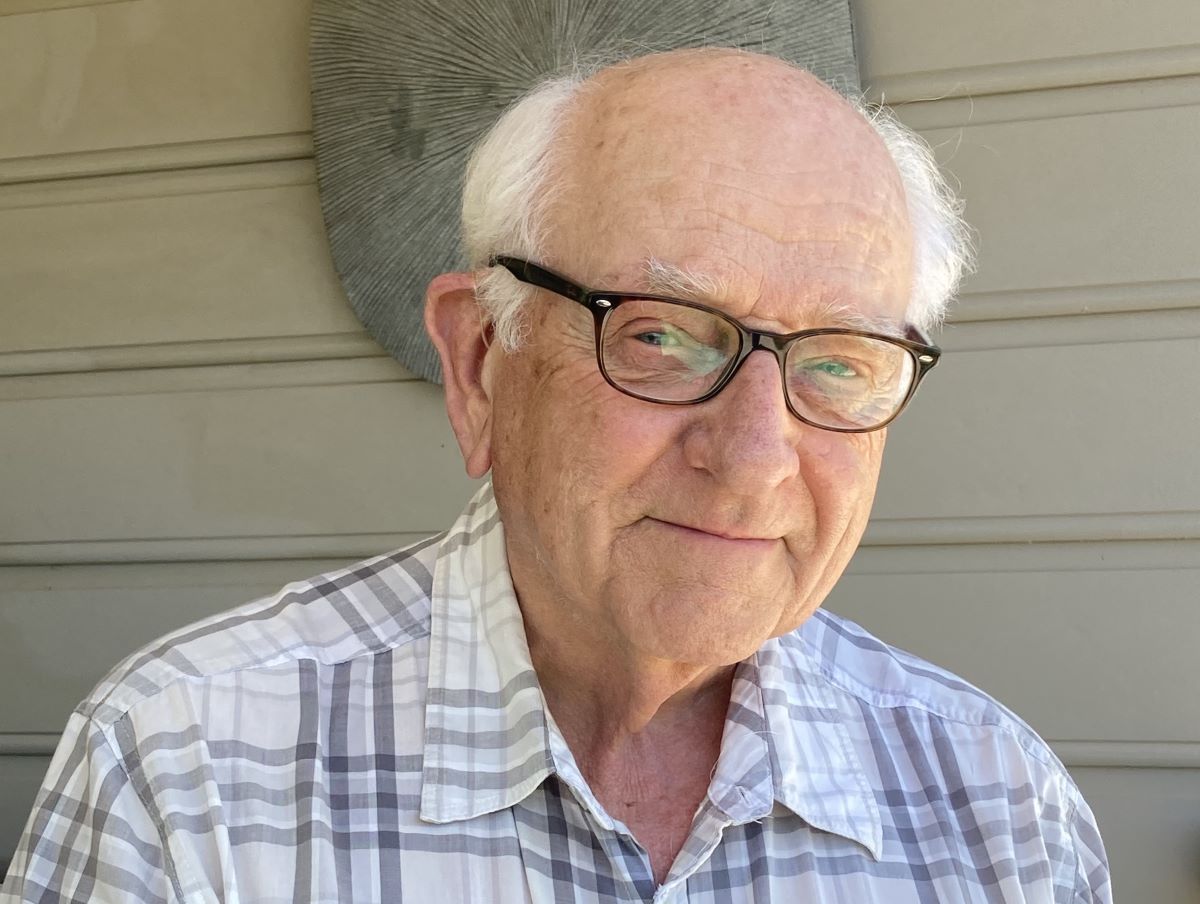
“I felt I was at last embarking on my life’s work and had the blessing of my family and the Church,” says Rev Dr D’Arcy Wood.
D’Arcy’s father, Rev Dr Harold Wood, a Methodist minister and former missionary in Tonga, joined local minister Rev Stan Weeks in laying hands on him. Bruce’s father, Rev Professor Calvert Barber, also participated, nine months before his death.
Bruce’s future wife Leonie was in the congregation, although they did not meet until two months later.
After ordination, their ministries took them in different directions.
D’Arcy says parish ministry “book-ended” his working life. He began in the Ballarat South Methodist Circuit, later serving City Church Canberra and Bentleigh Uniting Church.
The Ballarat appointment carried a family connection. His great-grandfather, Rev Theophilus Taylor, had been the first Wesleyan Methodist minister appointed to Ballarat.
“It was during the gold rush, and he lived in a tent,” D’Arcy says. “A little over 100 years later I took up ministry in a small part of the large circuit he served. His ministry was brief, as he died at age 29.”
Between parish appointments, D’Arcy taught theology at Parkin-Wesley Theological College in Adelaide for 15 years and worked in liturgy and church music. He later served as Moderator of the South Australian Synod, president of the Australian Council of Churches and President of the Uniting Church in Australia.
Bruce’s appointments also included Frankston-Karingal, a theology lectureship and college chaplaincy in Perth, North Melbourne Mission and the United Faculty of Theology, where he was Dean until retiring in 2001.
He describes that role as “a ministerial role of unprecedented privilege”.
Their ministries often kept them in different states, but their Church work repeatedly brought them together.
“Whenever we did meet it was very easy to take up the friendship again,” D’Arcy says. “We have always seemed to understand each other very well.”
They collaborated as examiners for the Melbourne College of Divinity and later held complementary national roles in the Uniting Church, D’Arcy in liturgy and Bruce in doctrine and church polity.
“My wife Janet even did a theology course with him at one stage,” D’Arcy says.
He admires Bruce’s theological ability and his “probing and somewhat restless faith”.
Bruce reaches for a football analogy to describe their different approaches.
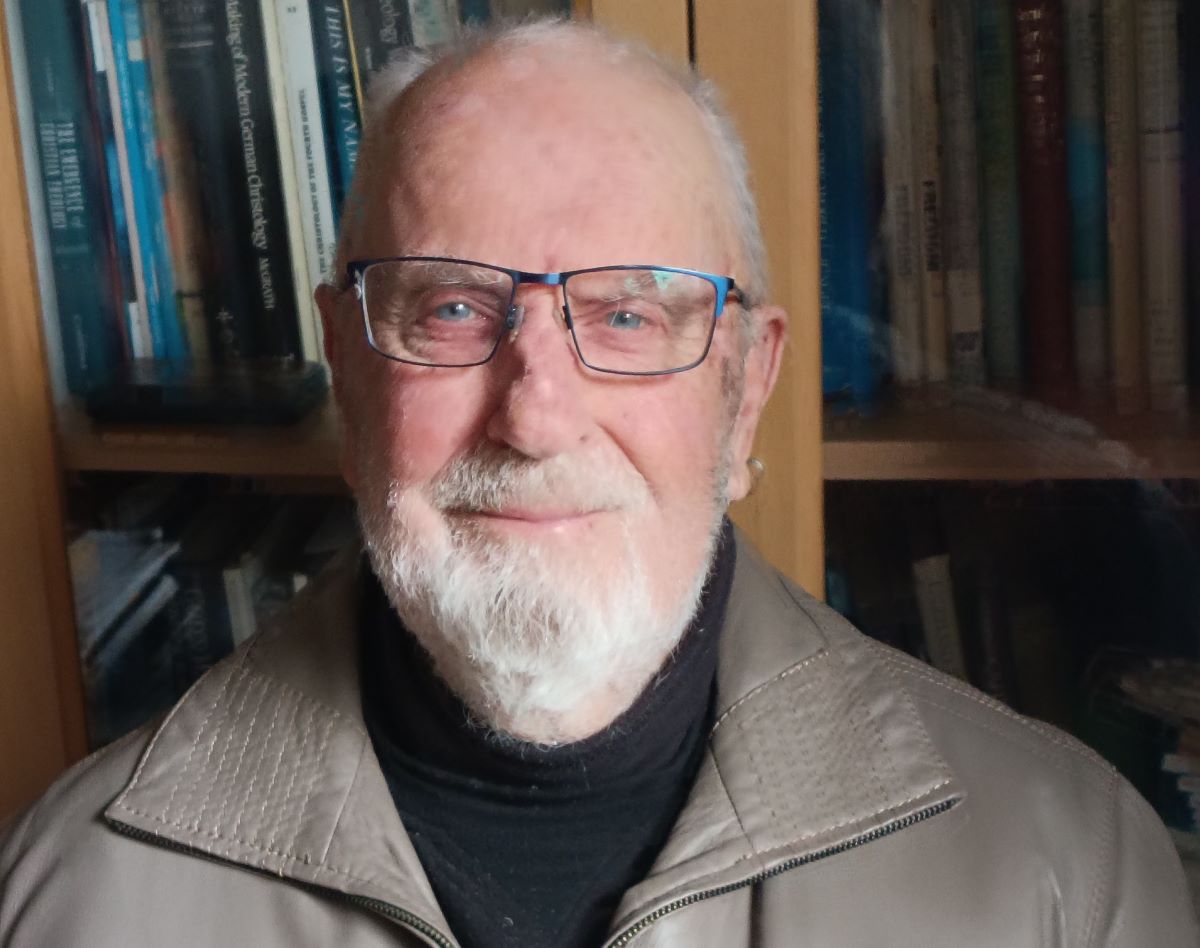
“I have wanted for nothing, and I have been offered everything,” says Rev Bruce Barber.
“D’Arcy has been the team’s ruckman, present at every bounce,” he says. “I, on the other hand, may perhaps have been a wingman attempting to rove the boundary.”
Their long friendship and ministries have also given them a view of how the Church’s place in Australian life has shifted.
“The Church has changed greatly since 1966,” D’Arcy says. “We are a smaller denomination. Society generally takes less notice of what we do and think.”
Candidates for ministry are also generally older than in the 1960s, “which is not a bad thing”, he says. “They have life experience.”
Bruce sees 1966, in hindsight, as the end of a period of relative stability and apparent flourishing for the churches. At Frankston, he regularly conducted three Sunday services and a fourth each month, even as social changes were beginning to reshape congregational life.
Bruce says that shared concern extends to the national Church bodies in which they served.
“I think it to be true that we both lament the disappearance of these fundamental bodies in later decades of the life of the Church,” Bruce says.
He says subsequent decades have borne out what he describes as Bonhoeffer’s warning that “the age of religion” is over. The continuing challenge, Bruce adds, is how to speak about Christian faith in a society increasingly identifying with no religion.
In 2000, D’Arcy and Janet retired to Gisborne, moving to nearby Riddells Creek in 2015.
“We have found the Gisborne congregation, and others in the Macedon Ranges, to be very supportive,” he says.
On Sunday, October 18, the Gisborne congregation and other churches in the Macedon Ranges Partnership will mark D’Arcy’s 60th anniversary of ordination.
Bruce and Leonie, who live in Ascot Vale, will be in Brisbane with immediate family.
“The timing is such that we couldn’t negotiate dates,” Bruce says. “So we will try to remember the date up there.”
D’Arcy, who turns 90 several weeks later, says he feels fortunate to have conducted worship and served the Church for so long.
“Over the years my faith has only strengthened.”
Bruce looks back with a similar sense of gratitude.
“This anniversary brings home to me the fact that my whole life has been one of unmitigated privilege,” he says. “I have wanted for nothing, and I have been offered everything.”
