

Sophia’s Spring participants pictured at a Pentecost service in May.
By Marina Williams
At Sophia’s Spring, the shape of worship reflects the shape of the community.
There is no pulpit, raised platform or single voice set apart. Each Sunday at CERES in Brunswick, chairs are arranged in a circle around a central table carrying symbols connected to the gathering’s theme, season and natural world outside. At a recent Pentecost service, butterflies were suspended as an image of the transformative Spirit descending on the community.
Pastor and Ministry Coordinator Christina Rowntree says the circle is intentional.
“All voices in the room are invited and encouraged, so the liturgy is always shared between the voices in the room,” she says.
Gatherings are prepared by members of a small liturgy group, with Christina preparing liturgy twice each month. The person leading worship writes the Order of Service, prepares a short reflection and invites others in the circle to respond.
“We are a learning community that doesn’t rely on the minister to be the one who does theological reading alone,” Christina says.
The story of Sophia’s Spring reaches back to Fitzroy Uniting Church, where feminist theology, social justice and inclusion had developed before the community moved from its bluestone building in 2009 to CERES, a setting better aligned with its “eco-feminist values and priorities”.
Sophia is the Greek word for wisdom and draws on a biblical tradition linking wisdom with creation and life, reclaiming feminine language for the Divine. The “spring” points to the Spirit as a source of renewal, grounded in creation.
Christina says the community draws on scripture, early church sources and theologians such as Rev Dr Sally Douglas, whose writing on Jesus Sophia has helped make Woman Wisdom accessible in practice and prayer.
“For us, honouring God’s good creation in our worship life infuses all we say and do, all we sing and celebrate, in the location within which we gather,” Christina says.
CERES sits beside the Merri Creek, where frogs and birdlife are part of the soundscape.
Sophia’s Spring meets on Sundays at 10am, except on the third Sunday of the month, when participants gather at 4pm. Each service begins by acknowledging Country, Wurundjeri elders and the Kulin seasonal cycle.
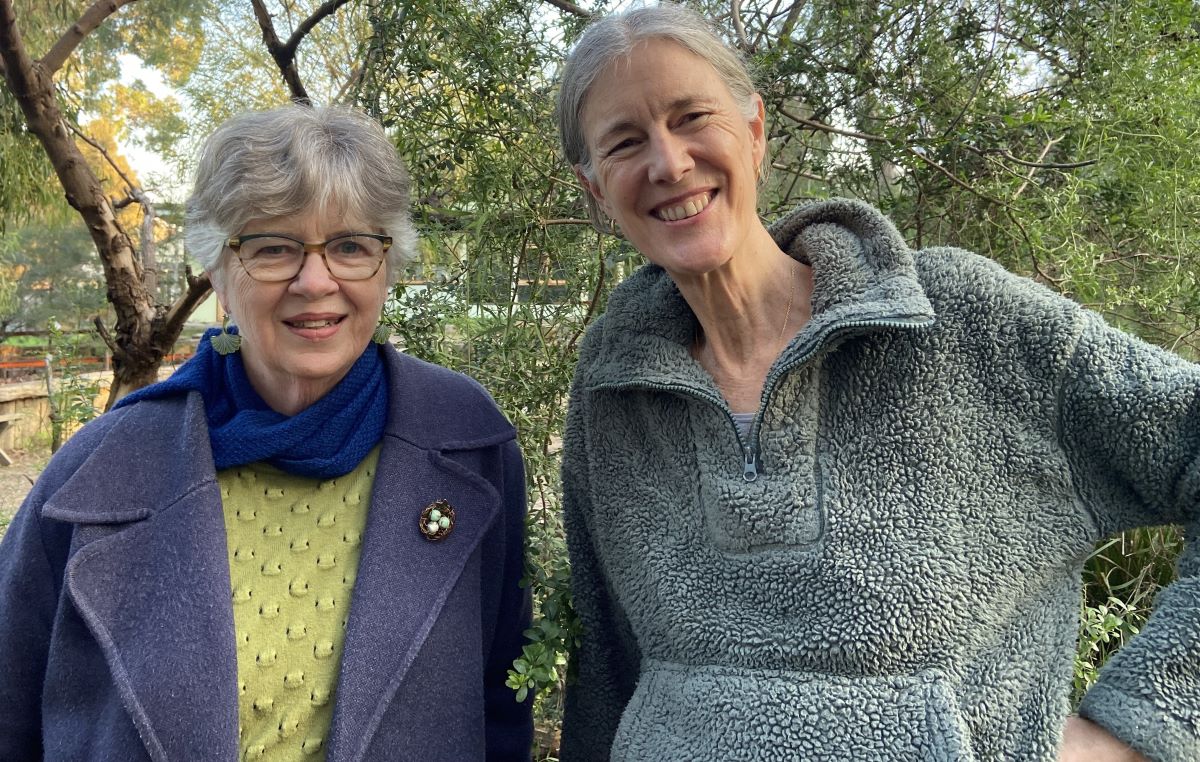
Christina Rowntree and Sue Pyke are part of eco-feminist worship group Sophia’s Spring.
Scripture is read alongside contemporary writing, poetry, ecological reflection and other sources of wisdom, with inclusive and gender-neutral language used throughout. Shared joys and concerns replace formal intercessions, and the sermon is replaced by a short, prepared reflection followed by shared responses.
“This is a key feminist principle,” Christina says. “The Service of the Word is not done by one person standing and speaking down to those seated.”
Instead, people offer reflections into the circle. Sometimes they break into small groups. Sometimes silence is allowed to sit. Different viewpoints can be held without needing to be resolved.
For participant Sue Pyke, part of Sophia’s Spring for more than a decade, shared reflection and inclusion are central to its life.
“I didn’t think this church existed anywhere other than in my imagination,” Sue says of her first visit.
After years of “church-hopping”, inclusive language was a “massive drawcard” and “a relief”. Sophia’s Spring, she says, has kept her connected to the Church and become “an anchor” for her faith practice.
“No one is the thought expert,” Sue says. “Everyone responds in a different way, and so your own understanding of your faith is informed by a whole lot of perspectives around the circle.”
Sue says a gathering may follow a familiar church shape, from welcome through to blessing, but can shift in response to a theme, question or facilitator: “Everything is kind of, let’s give it a go.”
Since moving to regional Victoria, Sue usually joins by Zoom. Sophia’s Spring moved online during COVID, then kept hybrid access so people who are ill, travelling or in aged care remain connected. For Sue’s hearing-impaired mother, captions also make participation possible in a way many physical church spaces do not.
The online connection continues mid-week through a Centring Prayer gathering, with acknowledgement of Country, joys and concerns, readings, silence and prayer. The readings are not always biblical, Sue says, but are “deeply rooted in respect for the sacredness of place”.
“It’s just beautiful,” she says. “It’s a reminder of something greater than just myself.”
The inclusive model of church is not without challenges, Christina says. Collaboration takes more time, and a feminist, participatory structure does not remove disagreement. But listening, learning and continuing to make space are part of a life drawing on feminist theology, First Nations voices, ecological writing, art, music and creative liturgical resources.
For those questioning more clergy-led or hierarchical models of church, Christina believes Sophia’s Spring offers another way to gather.
“The community of Sophia’s Spring is warm, vibrant and hospitable,” she says. “We delight in our shared life together, and joyfully welcome newcomers and seekers to our gatherings.”

Comments are closed.