
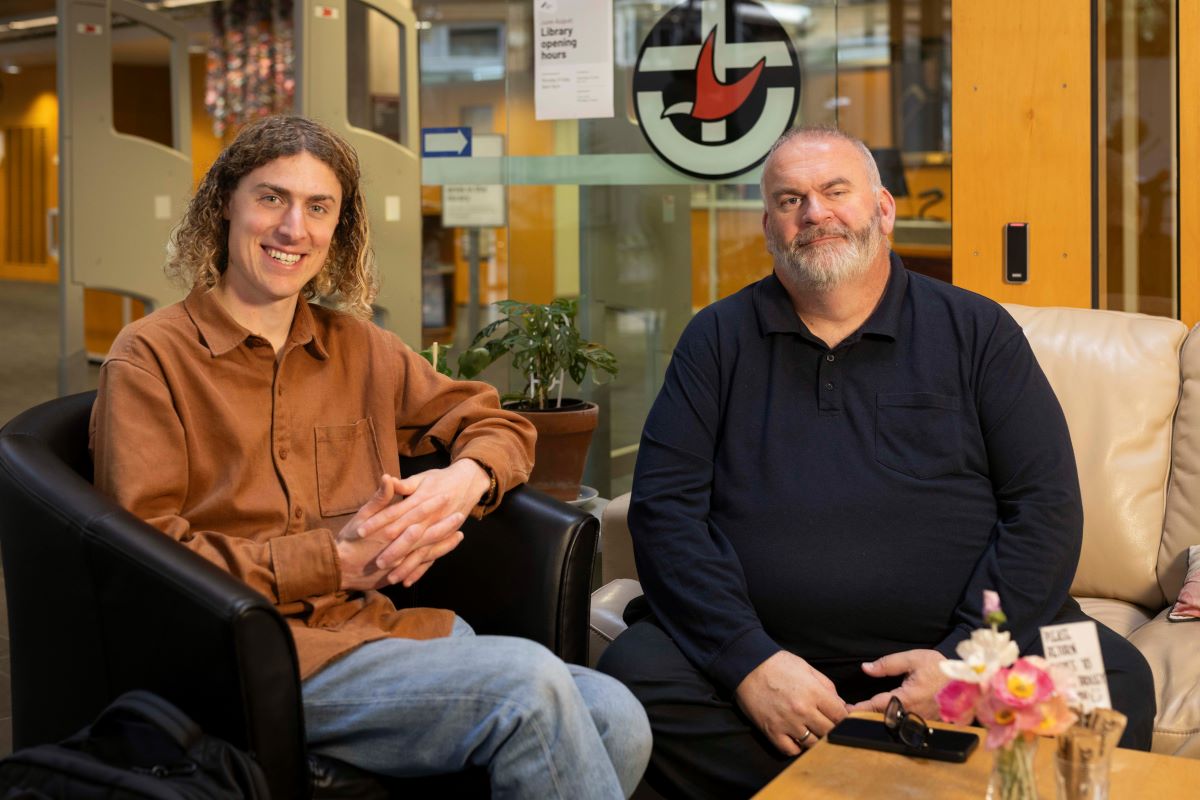
Brendan Byrne (right) and Tom Grayden are doing important work as chaplains at the University of Melbourne.
Initially, Brendan Byrne didn’t think he had what it took to be a university chaplain. But ministering to younger adults in congregations eventually prompted a move toward chaplaincy – and a whole new perspective.
“It’s been transformative, reshaping my ministerial identity in ways I never previously imagined,” he says. “I now have a new understanding of what it means to be a minister and a person of faith operating in a secular environment.”
For Brendan’s colleague, Tom Grayden, the path to chaplaincy was, by his own admission, slightly “backwards”.
“Instead of being a chaplain first and learning about a new context, I was shaped by my context as a university student, and then learned how to be a chaplain.”
Despite their different paths into chaplaincy, Brendan and Tom agree on one point: they love the work. While Brendan is the UCA’s Ecumenical Chaplain and Chaplaincy Co-Ordinator on the University of Melbourne’s Parkville campus, Tom is Chaplain at the University’s Schools of Fine Arts and Music campus on Southbank.
Brendan believes his past experience as a union official stands him in good stead as a chaplain.
“Union officials actually spend a good deal of time engaged in pastoral care, in companioning people through down-to-earth everyday issues,” he says. “There’s nothing performative or pretentious about it. Chaplaincy is in many respects the same.”
Tom feels his experience as a student at the school of music means he relates naturally to the needs of the performers and artists in his care.
“I see myself primarily as a listener and witness,” he says. “My role is to follow where God is already working in this community, and to see how my presence and attention can be a part of amplifying that work.”
Tom and Brendan also recognise the support of the university, as well as their respective congregations of Northcote and Wesley, are also important to their ministry.
Indeed, it’s that connection to the Church – and the assumptions it breeds – that can be the most helpful tool in making a connection.
“The moment when a student realises that, ‘despite’ being a person of faith, I am also a ‘normal’ human being like themselves, and that their assumptions and presuppositions about me are unwarranted, is always deeply gratifying,” Brendan says.
For Tom, being able to share “soul-level connection” in what can be a highly technical environment can make an enormous difference.
“A cheerful greeting in a corridor may turn into a deep conversation, or a casual chat over lunch may be just what someone needed to feel seen that day,” he says. “I am also contacted by people who want a listener, perhaps to name an anxiety they have, or to express a frustration, or to work through a problem.”
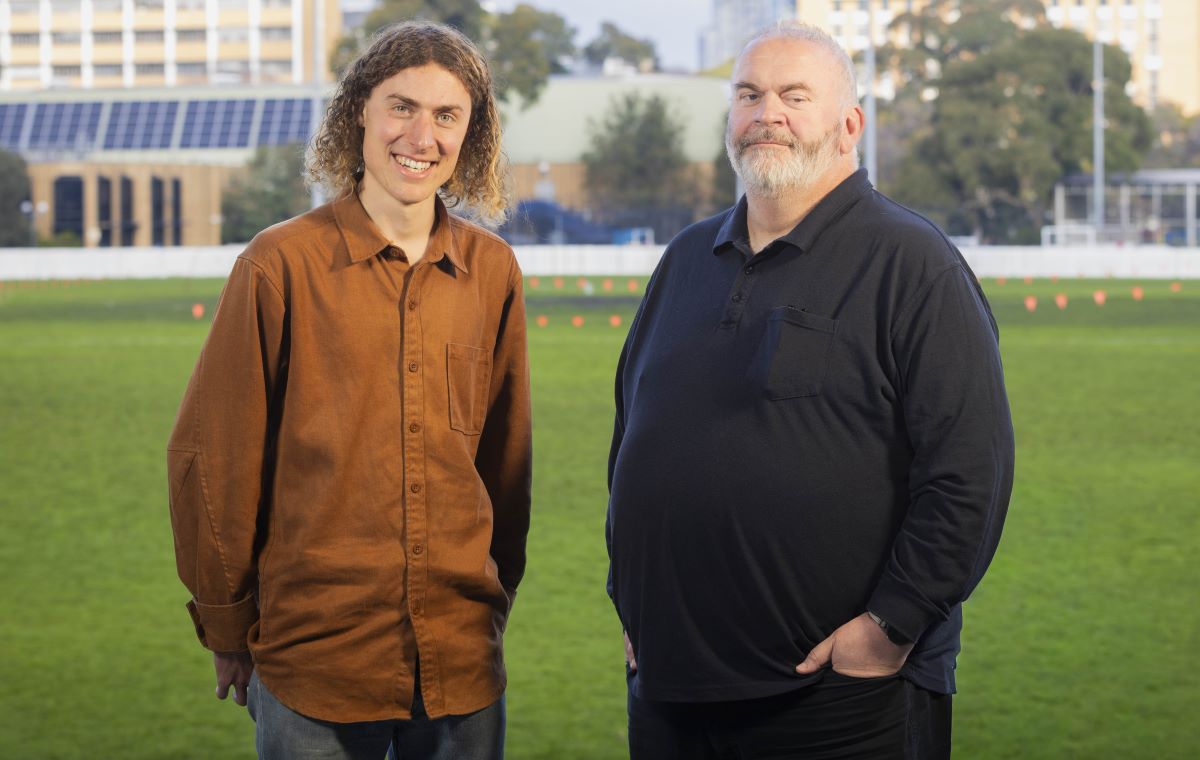
Brendan Byrne has come to chaplaincy while still a minister, while Tom Grayden was a university student before becoming a chaplain.
Brendan agrees.
“I never cease to be amazed by how frequently a casual conversation in a faculty kitchen or a chance encounter somewhere turns into a moment of disclosure, when someone makes themselves vulnerable to you by telling you something about themselves – perhaps something they’ve never told anyone before,” he says. “That’s the real value of chaplaincy: the capacity to connect with people through a moment of trust.”
Perhaps one of the most challenging aspects of chaplaincy is that it sometimes involves resisting the external pressures of our fractured and divided society.
“International conflict, the rising cost of living, incidences of racism or queerphobia – all these cause different parts of the university community to feel afraid or threatened,” Brendan says. “Chaplains occupy a difficult middle ground in which we stand in solidarity with suffering humanity, regardless of who they are or what community they come from, and try to persuade others toward self-reflection and respectful dialogue.”
Tom says this also sets chaplaincy apart from other forms of care, such as counselling.
“Chaplaincy has a different role to counselling,” he says. “Its unstructured, listening-focused, non-diagnostic nature doesn’t really have an equivalent elsewhere in the secular care system. It works naturally with other support services and across disciplines, allowing for fruitful collaborations with other Southbank staff and with student groups.”
Chaplaincy has shown Brendan that secular society contains many allies for the Gospel, irrespective of an individual or an organisation’s underlying affiliations.
“Whether it’s building links with student welfare services, or student unions, or on-campus groups, as a chaplain I can engage in collaborations that make a real difference to people’s lives,” he says.
Both Tom and Brendan agree this is perhaps one of chaplaincy’s least understood and yet most important aspects: its engagement with the day-to-day life of the world beyond the congregational and organisational life of the Church.
“I spend my time simply being part of the daily life of Southbank campus,” Tom says. “I feel blessed to be trusted by this community, and I look forward to seeing how this ministry role will settle in to the culture of the Faculty of Fine Arts and Music.”
“Chaplains are in many ways the public face of the Church,” Brendan adds. “That’s why the importance of their ministry needs to be recognised and properly funded and resourced.”
Chaplaincy Coordinator Rev Lauren Mosso says chaplains like Brendan and Tom do outstanding work in their respective roles.
“As Uniting Church chaplains, Brendan and Tom offer ministry that meets people where they are by coming alongside them with a supportive presence and deep listening,” she says.
“UCA chaplains are known for embracing diversity and offering authentic, compassionate and ethical ministry.”

Comments are closed.