
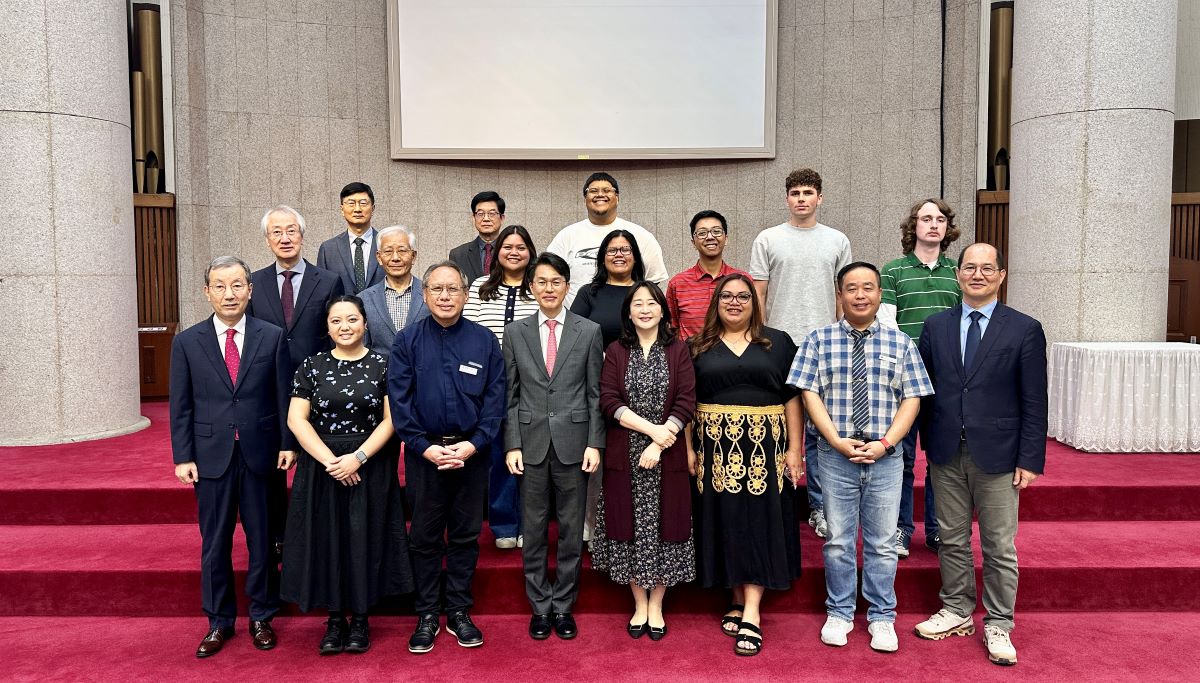
Rev David Dong Won Kim (front row, far right) and contextual learning group participants gained wonderful insights during their week-long visit to South Korea.
The contextual learning group’s visit to South Korea from April 13-20 was made possible with great support from the VicTas Synod, equipping Leadership for Mission, local congregations and leaders and many individuals.
The group was warmly welcomed by nine hosting organisations in Seoul, Busan, Masan and Changwon.
This exposure trip offered 11 participants a rare chance to experience firsthand the legacy and ongoing mission works of Australian missionaries who have served in Korea since 1889, a history both rich and largely unknown to many. Along the way, the group also built a bonding and binding fellowship and embraced the adventure of sampling unfamiliar, yet wonderful, local foods.
For one participant, the trip became a moment of personal reckoning. She admitted she had grown comfortable within her usual boundaries, and this experience was a deliberate choice to push beyond them. What surprised her most was her evolving understanding of colonisation, a word she had always associated with harm.
Learning about the courage Australian missionaries showed during the Japanese occupation (1910-1945), and witnessing the genuinely positive impact Australian missionaries who endured hardship along with the oppressed Koreans had during the colonisation and Korean War (1950-1953), offered her a fresh perspective.
Indeed, several Australian missionaries became living hopes among the suffering Koreans during the darkest and hardest time in Korean history. They refused to remain confined within church walls. It reached outward into society, confronting real social issues rather than retreating into the church. One of the participants shared that he believed the church would intentionally, yet faithfully, take both a responsibility and an opportunity to engage with the challenges facing communities today. He left with a renewed commitment to bring those lessons home, particularly the work being done with young people.
One of the group members who works in a hospital was deeply moved by the work of (missionaries) the MacKenzie sisters: their dedication to education and their fierce advocacy for women during an era when such advocacy carried real risk. She found their stories not just interesting, but genuinely inspiring.
Another participant was genuinely astonished to discover that despite attending a Christian school, he had never once been taught about the history of Australian missionaries in Korea. Learning about how they spread the Gospel across a foreign land was revelatory. He found the on-site context provided at each location particularly valuable in stitching together the broader story of faith and culture.
The nine participants had multicultural backgrounds, so the trip delivered an unexpected broadening of perspective for them. Having focused largely on their own congregation and immediate surroundings, the group became aware of a much larger story. As the children of immigrants, they felt the experience speak to them personally. It reinforced their belief that owning one’s identity means embracing all of it: Australian heritage and ethnic roots alike. The lesson they carried home was a simple but powerful one – ignorance is never an excuse and the past is something to learn from, not ignore.
One thoughtful participant offered a striking observation about the exposure trip as a whole. The overlapping stories heard at different sites and groups of people – the same history told through different voices and perspectives – reminded him of the four Gospels: one essential truth, illuminated through multiple perspectives. He found this layering deeply enriching rather than repetitive.
On behalf of the group, I want to express my deepest gratitude to everyone who supported and prayed for us.
We’ve gained more than inspiring memories and cultural experiences; we’ve also found a sense of calling, purpose and a commitment to serve in our Church, particularly with the next generation.

Comments are closed.