
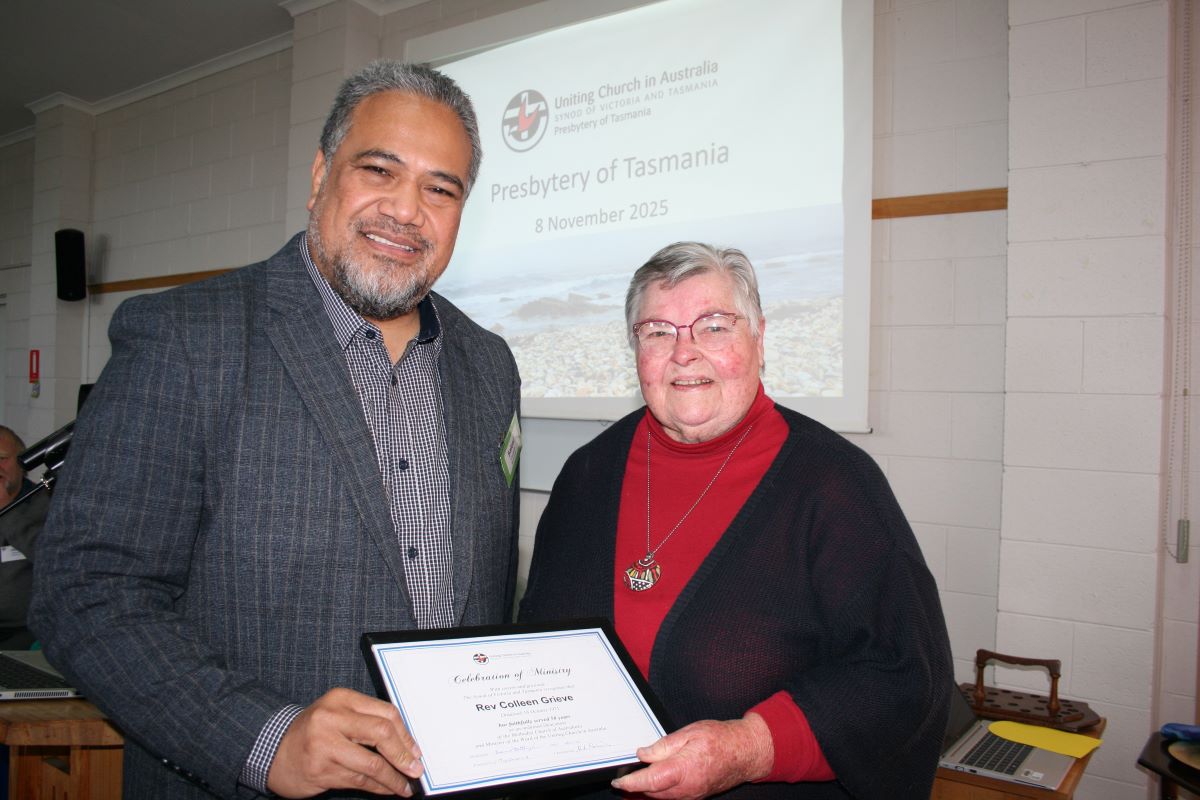
Rev Colleen Grieve with Moderator Rev Salesi Faupula and her recognition award.
By Marina Williams
In five decades of ministry, Rev Colleen Grieve has journeyed from the Atherton Tablelands and Mount Isa to Tasmania’s rugged west coast and northern midlands, guided by a faith grounded in Scripture and shaped through community.
On October 14 last year, former Synod of Tasmania Moderator Colleen celebrated 50 years of ordained ministry with a thanksgiving service at Longford Uniting Church, bringing together family, friends and former parishioners from across Queensland and Tasmania.
Born in Brisbane, Colleen was the second of five children and the first daughter in a working-class, tight-knit family.
“Mum was the one who nurtured our faith development,” she recalls.
“Rain, hail or shine, the Grieve kids were always at Sunday school and church.”
Those weekends made the church both a spiritual home and a social hub, filled with tennis, concerts and youth dances.
Her early role models were women of quiet strength.
“My grandmother … showed me how to be content with the home you make for yourself,” Colleen says, while an aunt who worked as a hospital matron revealed “the possibility of following a lifetime vocation”.
Their examples showed Colleen that a woman could lead a purposeful life beyond the conventions of the 1950s and 60s.
Even then, Colleen sensed the constraints of gender expectations.
“When both my brothers married, people would say, ‘you’ll be next’, and it annoyed me,” Colleen says.
“Why should that be the only path?”
At 14, she left school to work as an office assistant delivering precious metals around Brisbane.
Ten years later, after completing adult matriculation, she entered theological college.
“It took me a while to get there, but the call kept tugging,” Colleen says.
At ordination, ministers are presented with a Bible. For Colleen, that symbol had deep roots.
As a child, she eagerly read a Bible, a gift from her parents, long before theological study gave it new depth.
“It’s been my textbook for faith and for life, my prayer book, my spiritual roadmap,” she says.

The Bible has been a spiritual roadmap during Colleen’s faith journey.
One verse has been a constant presence in her life: ‘You yourself must keep calm and sane at all times; face hardship, work to spread the Gospel, and do all the duties of your calling’.
“It reminds me to stay faithful and steady, even when life is difficult,” Colleen says.
In 1974, her first fulltime appointment was as a probationary deaconess in the Methodist Church to Woodleigh Residential College in Herberton.
“Training for a Deaconess was a five-year training program,” she explains.
“You go to theological college for three years, which I started in 1971, then have a placement for the next two.
“Woodleigh was my placement, my probationary years, and at the end of my probation in October 1975 I was ordained.”
Colleen served as senior housemistress at Woodleigh to high-school students from remote Gulf and Cape York communities, the Torres Strait, Papua New Guinea and rural Queensland.
“For someone who’d never met indigenous people before, it was an eye-opening experience,” she says.
“At first, I held the same patronising attitudes many of us grew up with, but that soon changed.”
As she learned from the students about their families, languages and cultural stories, her world view shifted.
“Bit by bit I was challenged to reconsider everything I’d assumed,” Colleen says.
“It became one of the most profound learning experiences of my life.”
After four years, she was sent to Mount Isa, first as a Deaconess and later, following the formation of the Uniting Church, she was ordained as a Minister of the Word in February 1980.
“Effectively, I was ordained twice, which doesn’t happen often,” Colleen says.
“Minister of the Word is a congregational-based ministry, as opposed to the Order of Deacons, which is more of a community-based ministry.”

Colleen with her parents Colin and Thelma at her ordination as a Minister of the Word in 1980.
Friendships in the Mornington Island parish continued her education in Aboriginal life and spirituality.
“The women there adopted me as a sister,” she recalls.
“I felt deeply honoured.”
Those connections inspired later initiatives when she returned to Woodleigh as principal, including staff visits to students’ home communities to build trust with parents and elders.
By her final year, “every Year 12 student had plans for tertiary study”.
Later in Tasmania, Colleen studied Aboriginal history at the University of Tasmania and served as a presbytery representative with the Uniting Aboriginal and Islander Christian Congress.
“It was important to understand the story of the first Tasmanians, too,” she says.
“Reconciliation is a journey we walk together.”
After a decade in Queensland, and as the first woman appointed as a Frontier Services Patrol minister, Colleen moved south to the West Coast Patrol in Tasmania in 1990.
“It was wild, wet and dismal and yet beautiful,” she laughs.
“I wondered if I’d ever see the sun again.”
Then came hardship. Mines closed, hydro workers departed and communities emptied almost overnight.
“The population dropped from about 8500 to 3000,” Colleen says.
“People lived with a rhythm of doom and hope.”
Through it all, she supported her community.
“When our little church building at Savage River was sold and removed, we packed our chalices and hymn books into a box, our ‘holy box’, and became pilgrims again,” she says.
“It reminded me of the Ark of the Covenant travelling with God’s people.”
Beyond pastoral work, Colleen served on the inaugural Tasmanian Women’s Consultative Council and the Tasmanian Domestic Violence Advisory Committee, bringing a minister’s compassion to state policy discussions.
“It was outside the bounds of parish work, but part of caring for people’s wellbeing,” she says.
In 1996 she accepted a call to serve Longford, Perth, Cressy, Campbell Town, Ross and later Georgetown.
“After the transience of the West Coast it was a treat to be among people who’d lived in one place all their lives,” she says.
“I’ve spent nearly 30 years here and it’s been a joy.”

Colleen at her 1980 ordination with Rev Ila Amini and Rev Ron Smith.
When Colleen entered ministry, the Methodist Church maintained two separate orders: Minister of the Word for men and the “lesser status” Deaconess Order for women.
The formation of the Uniting Church in 1977 brought an equality between the orders, yet prejudice lingered.
“There were ministers who didn’t believe women should be ordained,” Colleen recalls.
Over time, attitudes shifted.
“There are now so many women in ministry that gender isn’t the issue it once was,” she says.
“Those early struggles, I hope, helped soften the path for others to follow.”
In 2001, Colleen was installed as Moderator of the Synod of Tasmania, a defining moment she describes with quiet humility.
“When colleagues laid hands on me and prayed, I realised how every step of my life had brought me to that point,” she says.
That same year she received the Centenary Medal for ‘community service above and beyond a professional role’.
Throughout her ministry she has encouraged others, particularly women, discerning a call to leadership.
“All we’re asked to do is to contribute one faithful life,” she says.
“It sounds simple, but it takes commitment.”
Now in retirement, Colleen continues to be involved locally in Longford, marking her 80th birthday in February last year by “handing over a few responsibilities”.
She still tends her vegetable garden, meets old friends and is a holiday host for her Queensland family.
Looking back, Colleen sees her life shaped by faith, service and grace.
“I never felt I needed marriage or motherhood to complete me,” she says.
“My life has been full and blessed with people who’ve loved, cared for and respected me.
“The Church has been my extended family.
“Having lived a long and faithful life, I hope, is a goal I’ve achieved.”
